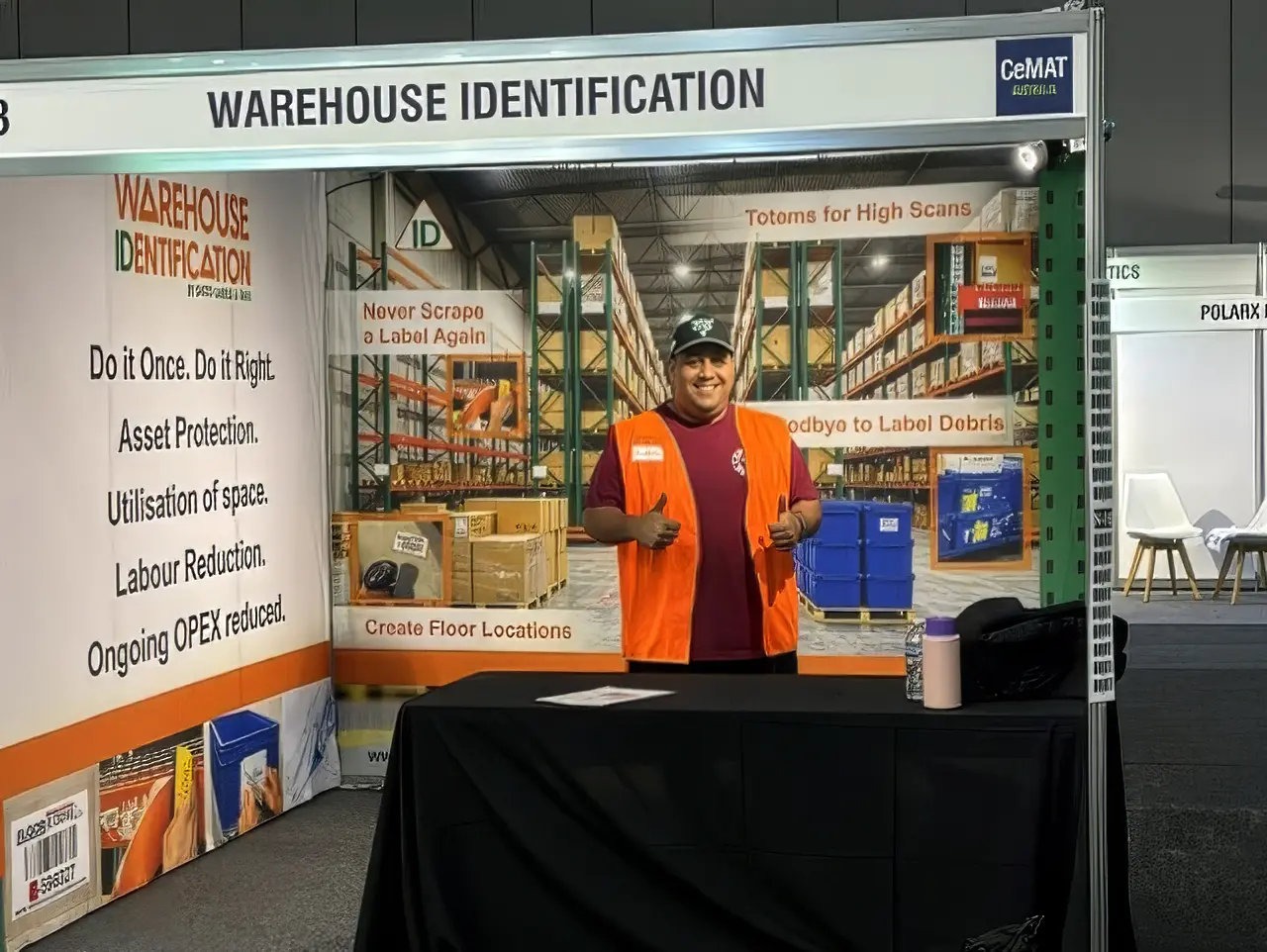
Three days. Hundreds of conversations. One consistent message. Warehouse operators aren’t looking for more labels. They’re looking for identification systems that continue to work long after the installation team has left.
That was our biggest takeaway from CeMAT Australia.
Over the course of the exhibition we spoke with operations managers, warehouse supervisors, logistics providers, automation specialists, systems integrators and business owners from across Australia and New Zealand. While every warehouse was different, the challenges they described were remarkably similar.
The same problems keep appearing
Almost every conversation touched on one or more of these issues:
- Warehouse location labels becoming damaged by forklifts or pallet movement.
- Adhesive residue left behind when layouts change.
- Expensive labour spent removing old labels during warehouse reconfigurations.
- Inconsistent aisle, bay and level identification making navigation difficult.
- Signs that become unreadable from forklift operating distances.
- Warehouse expansions that force entire identification systems to be redesigned.
- Ongoing relabelling projects becoming accepted as “just part of running a warehouse.”
Many businesses have become so accustomed to these problems that they simply budget for continual replacement rather than questioning whether there is a better approach.
Warehouse Identification should be designed, not repaired
One of the most rewarding aspects of CeMAT was seeing people’s reactions when they realised warehouse identification doesn’t have to work that way. Rather than offering individual products in isolation, our conversations focused on designing identification systems that remain practical throughout the life of the warehouse.
That includes considering:
- Warehouse layout and traffic flow
- Viewing distances for forklift operators
- Future warehouse expansion
- Barcode scanning requirements
- Human readability
- Maintenance and replacement strategies
- Long-term operating costs
When these factors are considered together, warehouse identification becomes infrastructure rather than consumables.
Solutions that generated the most interest
Several products consistently attracted attention because they solve problems warehouse teams deal with every day.
Repositionable Warehouse Labels
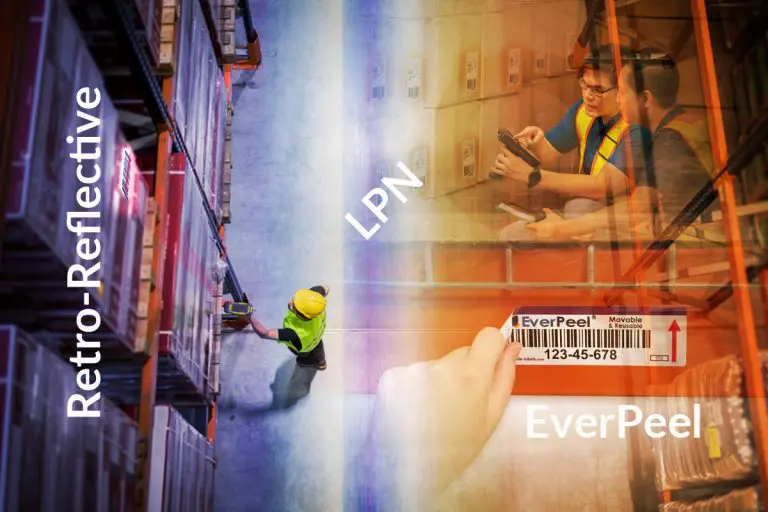
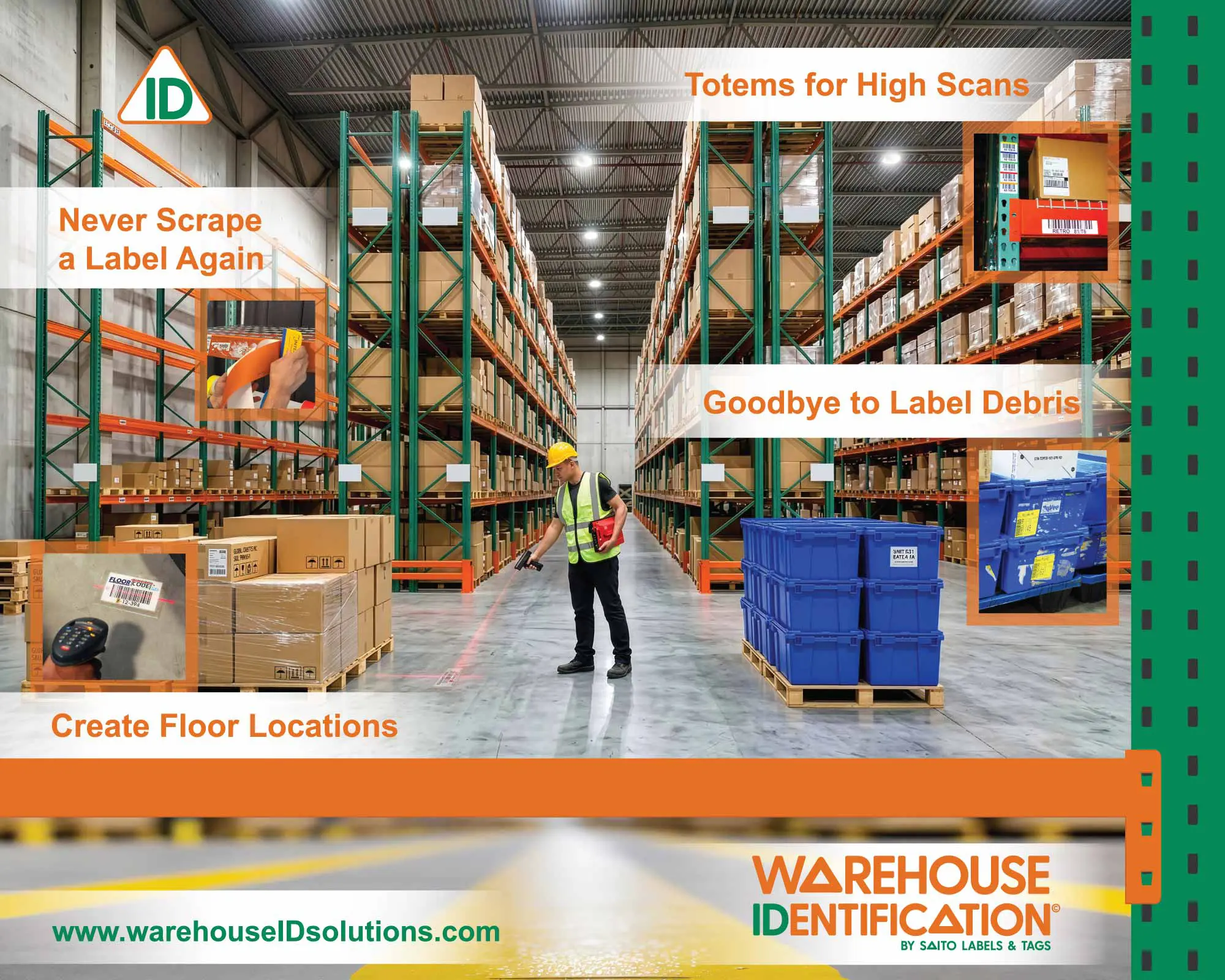
Traditional permanent adhesive labels often become one of the biggest maintenance headaches inside a warehouse. Our Everpeel® repositionable warehouse labels allow locations to be updated without leaving adhesive residue or damaging painted racking. As warehouse layouts evolve, labels can be removed cleanly, relocated where appropriate, and replaced in a fraction of the time required for conventional labels.
For many visitors, this wasn’t simply about replacing a label—it was about reducing future labour costs.
Surface Protection Tape
Many warehouse managers told us they spend significant time scraping old adhesive from expensive racking whenever locations change. Our surface protection tape provides a sacrificial layer between the rack and the location label. Labels adhere securely to the tape rather than directly to the steel, making future replacement fast while helping protect painted rack surfaces.
It’s a simple idea that immediately resonated with maintenance teams responsible for keeping warehouses looking professional.
Etched Aluminium Totems and Upright Cards
Long-distance warehouse identification continues to be one of the biggest challenges in modern facilities, particularly as warehouses become taller and forklift operating distances increase. Our etched aluminium totems and upright identification cards provide highly durable aisle and location identification that resists impact, fading and harsh warehouse environments.
Combined with retro-reflective materials where appropriate, these solutions make locations easier to identify from greater distances while supporting faster navigation throughout the warehouse.
Retro-Reflective Long-Range Scanning
Interest in long-range barcode scanning continues to grow, particularly in high-bay warehouses and facilities using forklift-mounted scanners. Retro-reflective barcode labels improve scan reliability over greater distances by reflecting scanner light more efficiently than conventional label materials. For many warehouses, this reduces scanning delays while improving inventory accuracy.
Warehouse Location Labels Built for Change
Many visitors were surprised by how much thought can go into something as simple as a warehouse location number.
Choosing numbering systems that allow for future expansion, selecting durable materials suited to the environment, planning viewing angles, and considering future automation all contribute to identification systems that continue working as warehouses evolve.
Good warehouse identification isn’t just about today’s layout—it’s about avoiding expensive redesigns tomorrow.
More Than Labels
One thing became increasingly clear throughout the exhibition. Many visitors initially approached us looking for labels. The conversation usually ended with warehouse strategy.
That’s because labels are only one component of an effective identification system.
A complete warehouse identification solution may include:
- Racking location labels
- License Plate Number (LPN) labels
- Retro-reflective barcode labels
- Aisle signs
- Bay and level markers
- Upright totems
- Floor identification
- Bulk storage markers
- Staging and dispatch zone identification
- Cross-docking and transit signage
- Mobile printer labels
- Asset identification
- Warehouse numbering strategies
When these elements are designed as a complete system, warehouses become easier to navigate, simpler to maintain and better prepared for future operational changes.
The Industry is thinking Long-Term
Another encouraging takeaway from CeMAT was seeing how many organisations are now thinking beyond the initial installation cost.
Warehouse managers are increasingly asking questions like:
- How long will this solution last?
- What happens when the warehouse changes?
- How difficult will it be to maintain?
- Can it support automation?
- Will it still work in ten years?
Those are exactly the conversations we enjoy having because they focus on total cost of ownership rather than simply purchasing another batch of labels.
Thank You
To everyone who visited our stand—thank you. Thank you for sharing your warehouse challenges, asking thoughtful questions and giving us valuable insight into the realities of modern warehouse operations.
One of the most satisfying outcomes from CeMAT wasn’t simply the number of conversations we had. It was the confirmation that the long-term approach we’ve been quietly developing over many years genuinely addresses problems warehouse teams experience every day.
We don’t see ourselves as simply manufacturing labels. We help organisations design warehouse identification systems that are durable, maintainable and built to evolve alongside their operations.
The conversations certainly didn’t end when the exhibition closed, and we’re looking forward to working with many of the people we met over the coming months.
If CeMAT reinforced one thing for us, it’s this:
The future of warehouse identification isn’t about replacing labels more often.
It’s about needing to replace them less.
Planning a warehouse upgrade or relabelling project?
Talk to us about a warehouse identification system designed to last, adapt and reduce future relabelling work.