How to Improve Long-Distance Barcode Scanning
Long-distance barcode scanning allows operators to capture information from several metres away without leaving their equipment. This is particularly valuable in high-bay warehouses where forklift drivers need to confirm locations or pallet positions without physically approaching every label.
Successful long-range scanning requires more than simply printing a larger barcode. Factors such as barcode size, quiet zones, mounting position, label material, lighting conditions, scanner capability, and the angle of approach can all influence performance. Warehouses often experience scanning issues because labels were designed for handheld use rather than the actual distances encountered on the warehouse floor.
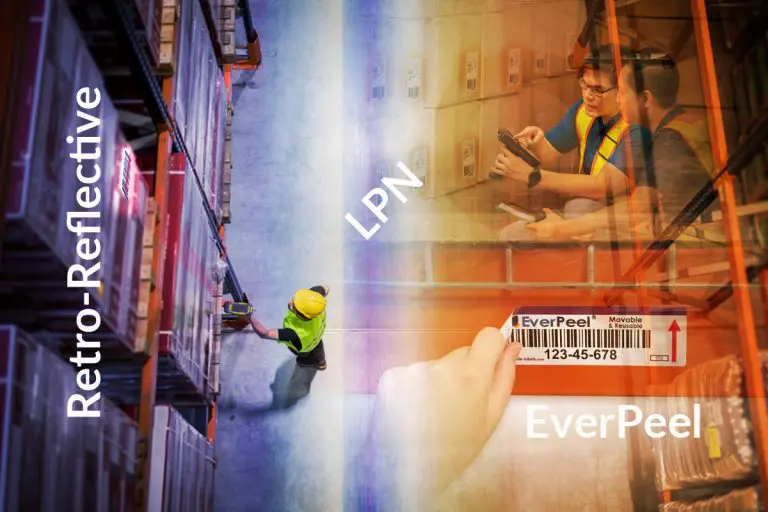
Specialised long-range barcode labels are also available. These labels typically use reflective backing materials that improve scanner performance at greater distances and under challenging warehouse conditions. While they can be highly effective, the additional cost often makes them less attractive for large warehouse installations.
There are also several approaches to reducing scan distance requirements altogether. Rather than placing barcodes at every elevated rack position, some facilities use ground-level location markers or totems that can be scanned safely from the warehouse floor. This allows operators to confirm locations without needing to scan labels mounted several metres above ground level. In many cases, this approach is chosen because it delivers reliable scanning performance at a significantly lower cost than installing specialised long-range labels throughout the facility.
In other environments, businesses choose to barcode only the rack level or aisle position, while individual locations are identified using human-readable numbering. This approach can reduce installation costs while still providing sufficient accuracy for warehouse operations. The most suitable solution depends on factors such as rack height, scanning equipment, inventory accuracy requirements, and the warehouse management system being used.
Long-distance barcode systems should always be designed around the way the warehouse operates. Testing labels, scanners, mounting locations, and viewing distances under real operating conditions can significantly improve productivity while reducing scanning errors and operator frustration.
What We See In Real Warehouses
Most conversations about long-distance barcode scanning begin with the physical environment. Clients typically come to us with information such as rack heights, warehouse layouts, operating temperatures, and whether the facility is ambient, chilled, or frozen. From there, the challenge is not simply determining how far a barcode can be scanned but identifying the most practical and cost-effective way to make locations visible to operators.
While specialised long-range barcode materials and scanning technologies continue to evolve, we have found that many warehouses achieve better outcomes by focusing on identification strategy rather than scan distance alone. Totems, aisle markers, level identification, and clear location numbering can often improve usability more effectively than larger or more complex barcodes.
The goal is not necessarily to scan further. The goal is to make locations easier to identify. The best solution is usually the one that balances performance, cost, operational workflow, and future flexibility rather than relying on a single piece of technology.